
The global geopolitical order is undergoing a profound transformation. Power is increasingly shifting away from a small group of dominant states toward a more complex structure. Against this backdrop, representatives from politics, academia, and the private sector convened in Berlin on 14 April 2026 to discuss the future of relations between Europe and Africa.
Shaping New Partnerships in a Multipolar World
Europe and Africa in Global Power Shifts
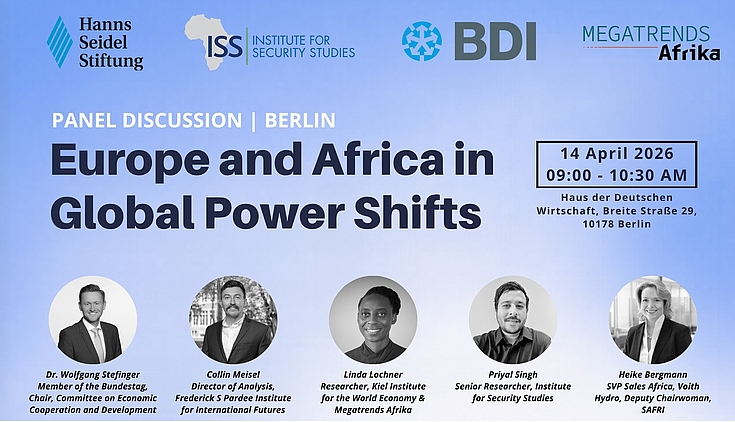
Invitation for the topical panel discussion in Berlin
HSF
The event, organised by the Hanns Seidel Foundation South Africa in cooperation with the Federation of German Industries (BDI), the Institute for Security Studies (ISS), and the Megatrends Afrika initiative, also marked the launch of a new research and dialogue initiative on the long-term implications of global power shifts on Africa-EU relations.
Africa and Europe in a Changing Global Context
A central focus of the discussion was how global power dynamics are likely to evolve by mid-century and what role Europe and Africa will play in this process. While the United States and China are expected to remain key actors, an increasing number of states and regions are gaining influence. Long-term scenarios by the Frederick S. Pardee Center at the University of Denver show that in the coming decades, power in the international system will become increasingly diffuse. Along the current trajectory the researchers predict, the US and China will possess roughly equal power by mid-century and share the top place in the global hierarchy, followed by a combined EU (assuming its member nations work in concert) with roughly half as much power, India sitting in a distant third at roughly half the level of the EU, and every other country well below that.
Africa occupies a particularly important position in this context. Africa is not only a partner of Europe but increasingly a shaper of global rules. With its young and rapidly growing population and expanding economic potential, the continent is gaining new strategic agency. Europe, on the other hand, is facing significant demographic challenges, further deepening interdependencies between the two regions—particularly in the areas of migration, labour markets, and economic cooperation.
Both continents are affected by external shocks such as the war in Iran, and most African and European countries are aiming towards a rules-based order, which is under threat.
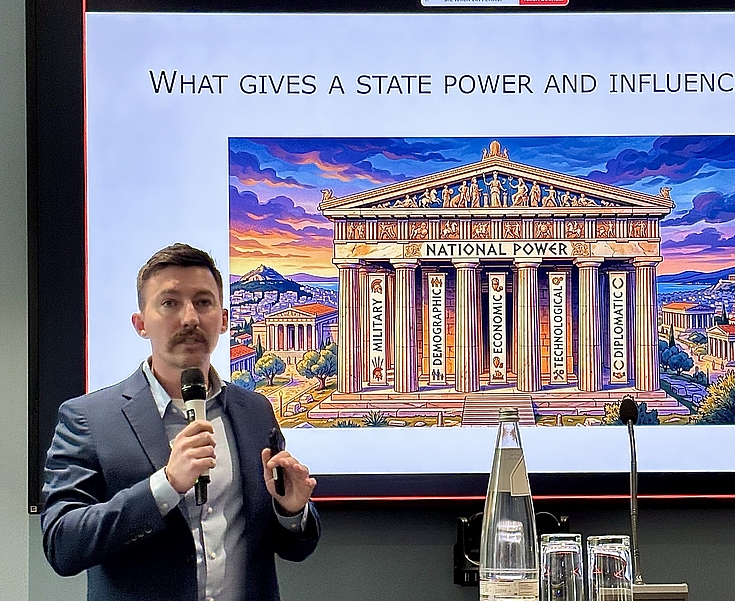
Collin Meisel, Director of Analysis at the Frederick S. Pardee Center for International Futures at the University of Denver
At the same time, rising geopolitical competition between major powers is creating new risks and may constrain the strategic options of other states. Collin Meisel, Director of Analysis at the Frederick S. Pardee Center for International Futures at the University of Denver, noted:
“On the one hand, many African states—particularly Nigeria—are likely to become more influential as their material capabilities grow and they gain more options for partnerships with non-traditional actors such as India. On the other hand, conflictual relations between major powers—especially the United States and China—may force other countries to take sides, for example in relation to technological standards. As the saying goes: when the elephants fight, the grass gets trampled.”
Global Crises and Their Impact on Africa
The discussion also highlighted the extent to which global crises affect African states. Russia’s war of aggression against Ukraine and conflicts in the Middle East have immediate repercussions for energy prices, food security, and inflation, while exacerbating underlying structural challenges.
“Rising global defence spending is diverting resources that would otherwise be needed to address development and governance deficits”, says Priyal Singh from the Institute for Security Studies. At the same time, many intra-African conflicts—such as those in the Sahel, the Horn of Africa, and the Great Lakes region—are receiving diminishing international attention.
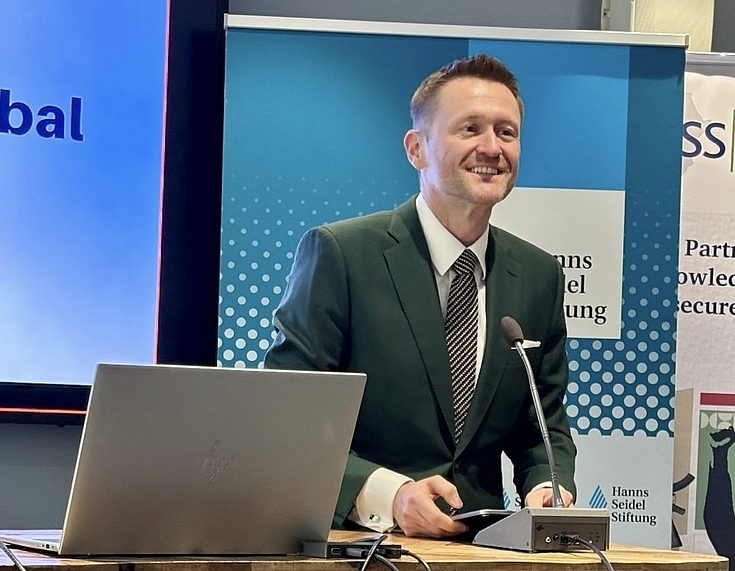
Dr Wolfgang Stefinger, Member of the German Bundestag and Chair of the Committee on Economic Cooperation and Development
HSF
Rethinking Development Cooperation: From Aid to Economic Partnership
A key takeaway from the event was the need to fundamentally rethink development cooperation. Traditional models are increasingly insufficient in the face of global transformation processes.
Dr Wolfgang Stefinger, Member of the German Bundestag and Chair of the Committee on Economic Cooperation and Development, emphasised:
“This event addresses precisely what we urgently need in policy terms: a reorientation of development policy—away from pure development aid and toward genuine economic cooperation. We must also be honest: for too long, we have struggled to clearly articulate our interests. Development policy and national interests were often seen as contradictory. In reality, the opposite is true. Those who conceal their interests do not treat their partners as equals—they reduce them to recipients. True partnership can only emerge when both sides are transparent about their objectives. And our objective is clear: we want stable and prosperous partner countries with functioning markets, a strong private sector, and real growth prospects”.
In this context, the integration of African economies into regional and global value chains, as well as the development of industrial capacities, are essential prerequisites for sustainable growth.
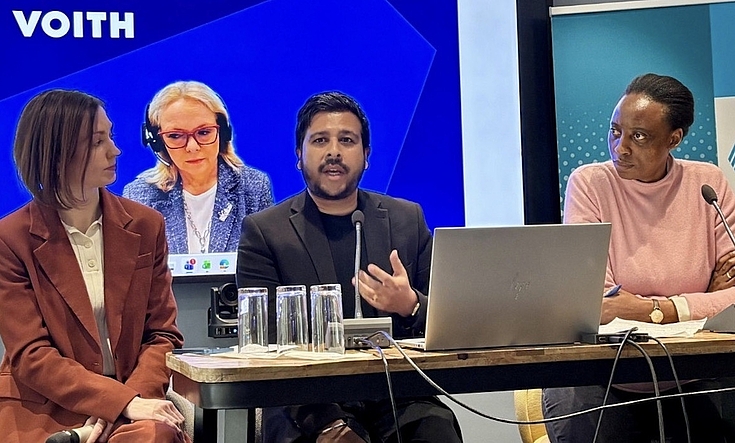
Moderator Lena Gutheil with Panelists Heike Bergmann, Priyal Singh and Linda Lochner
HSF
From Ambition to Implementation: The Role of the Private Sector
The discussion also made clear that the main challenge lies not in analysis, but in implementation. Heike Bergmann, Deputy Chair of the Sub-Saharan Africa Initiative of German Business (SAFRI) and representative of Voith, summarised this point:
“For a balanced Africa–Europe partnership, we must move from ambition to execution—and from dialogue to delivery.”
Rule of Law as a Foundation for Investment
Sustainable investment depends on stable and transparent conditions.
These include:
- legal certainty and reliable contract enforcement,
- protection of property rights,
- and effective, accountable institutions, as well as security.
Without these foundations, investment remains limited and economic transformation is hindered. As economist Linda Lochner of Megatrends Afrika noted, security and transparent, accountable institutions are essential prerequisites for investment and must be strengthened through deeper Africa–Europe cooperation.
Strategic Competition and New Partnerships
Africa–Europe relations are increasingly shaped by global competition. Alongside Europe, actors such as China, Russia, the United States, and countries from the Middle East are expanding their engagement on the African continent.
While this offers African countries new opportunities to diversify partnerships, it also increases competitive pressure on Europe. A more strategic, coherent, and long-term approach to cooperation is therefore essential.
Launch of a New Multi-Stakeholder Initiative
The Berlin event marks the beginning of a joint initiative between the Hanns Seidel Foundation, the African Institute for Security Studies, Megatrends Afrika, and the Federation of German Industries. This collaboration between African and German think tanks and the private sector aims to analyse the impact of global power shifts and develop concrete policy recommendations for a modern and forward-looking Africa–EU partnership.
Conclusion: Shaping the Partnership of the Future
The discussion made one thing clear: relations between Europe and Africa are at a turning point. In an increasingly multipolar world, the quality of partnerships will be decisive. Europe and Africa have the opportunity to shape a relationship based on shared interests, economic development, and strong institutional foundations.
The key question remains: Will Europe and Africa actively shape this transformation—or be shaped by it?
Subscribe to our Newsletter to receive event invitations and new publications via email - and follow us on Facebook, Twitter and LinkedIn for news about our work.