
Event in new EU-Africa cooperation project
Panel discussion on critical minerals
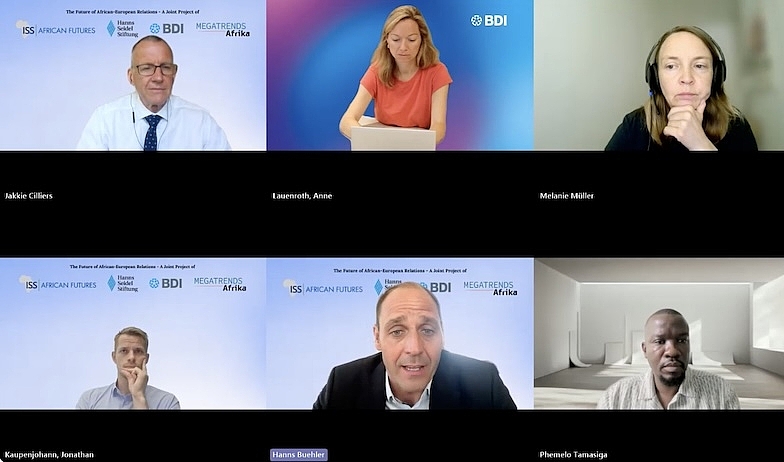
The speakers during the event
BDI/HSF
These were our excellent speakers for the panel discussion:
Welcome:
Hanns Bühler, Resident Representative, Hanns Seidel Foundation South Africa
Speakers:
* Jakkie Cilliers, Chairman of the Board and Head of African Futures & Innovation, Institute for Security Studies (ISS)
* Anne Lauenroth, Senior Expert Raw Materials; Federation of German Industries (BDI)
* Dr. Phemelo Tamasiga, Senior Researcher, German Institute of Development and Sustainability (IDOS)
* Melanie Müller, Deputy Head of Research Division Africa and Middle East, German Institute for International and Security Affairs (SWP)
Moderator:
Jonathan Kaupenjohann, Expert Sub-Saharan Africa, Federation of German Industries (BDI)
Here are some of the key insights they shared during the event:
Jonathan Kaupenjohann, BDI
Many countries have exported raw materials in the past while capturing only a limited portion of the economic benefits generated along global value chains. The challenge is to reconcile different interests. Europe seeks diversified, reliable supply chains. African countries seek industrialization, local processing, and sustainable economic development. The opportunity lies in recognizing that these objectives need not be contradictory.
Hanns Bühler, HSF
What I hear from people in industry and our African partners is that Germany and Europe must now move from debating to action. I think we must really address raw material partnerships with greater urgency, speed, and determination. At the same time, we should not be naive. African countries have many potential partners competing for cooperation nowadays. And we, Europe, must just present a more attractive offer.
Anne Lauenroth, BDI
In Germany, we have a lot of manufacturing machinery expertise. Africa has a lot of resources and capacity for growth - so it's about facilitating value-added material processing. Transparent partnerships that promote sustainable, high-quality, resilient and traceable supply chains, supporting global industrial growth together – that's where we should go.
Jakkie Cilliers, ISS
Much attention focuses on lithium and cobalt, but many analysts argue that copper may become the most important constraint because electrification requires enormous quantities. If copper emerges as the principal bottleneck in the global energy transition, Africa, with its large share of production and vast reserves, becomes considerably more strategically important than it is today.
Dr. Phemelo Tamasiga, IDOS
Cooperation must build domestic productive capability in African countries — suppliers, processing, skills, and institutions. Capability is the route to African value capture, and the guarantee of durable European supply, so the two agendas are complementary, not zero-sum. Judge partnerships by the capability created, not tonnes secured!
Melanie Müller, SWP
On German-South African cooperation, I'd say these are two middle powers that need each other. The critical question is, how do we move from announcements to implementation? Decision makers say we're tired of announcements and must identify the business cases. German companies, for example, would be keen to explore cooperation on electrolyzer production in SA. So this may be one area to look at joint business interests: which companies do we have in SA and in Germany, and how could it be brought together.
Subscribe to our Newsletter to receive event invitations and new publications via email - and follow us on Facebook, Twitter and LinkedIn for news about our work.